
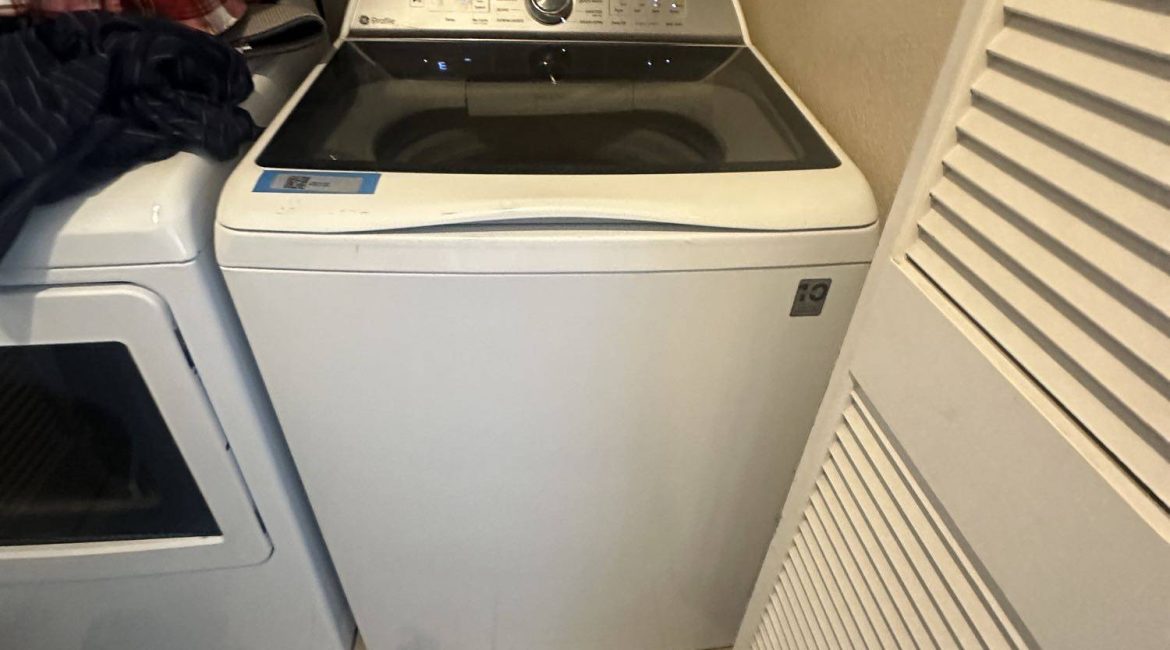
When a washing machine fills with water but the agitator stays still, the cycle is clearly starting but something inside the mechanical or electrical drive system is failing to transfer power. The result is simple: the drum sits idle while the timer continues running. This type of issue usually points to a fault in the drive components, motor system, or mechanical linkage between them.
Understanding where the breakdown occurs helps narrow the problem before it escalates into a full machine failure.
Motor runs, but motion doesn’t transfer
In many cases, the motor itself is still functioning. You may hear a humming sound or even a brief attempt to start agitation. If the agitator does not respond, the issue often lies between the motor and the drum.
Common causes include a worn motor coupling, damaged drive belt, or a slipping clutch assembly. In belt-driven machines, a loose or broken belt is one of the most frequent reasons the agitator stops moving while the motor still runs. In direct-drive systems, the motor coupling can wear down over time and fail to transmit rotation.
Lid switch or door interlock failure
Modern washing machines are designed not to agitate if the lid or door is not properly secured. A faulty lid switch can interrupt the agitation cycle even when everything else is working. If the machine fills with water but does nothing afterward, testing the lid switch is one of the first diagnostic steps.
This component is small but essential. When it fails, the machine assumes the lid is open and disables motion for safety reasons.
Drive belt wear or breakage
In belt-driven models, the belt connects the motor to the transmission or drum pulley. Over time, it can stretch, crack, or slip off the pulley entirely. When this happens, the motor spins freely but the agitator receives no power.
A visual inspection (after unplugging the machine) can often confirm this issue. A loose or broken belt is usually inexpensive to replace but requires correct installation tension.
Motor coupling damage
Direct-drive washing machines use a coupling that links the motor directly to the transmission. This coupling is designed to absorb stress and can break under heavy loads or long-term wear.
When it fails, the motor may still run, but no movement reaches the agitator. Replacing the coupling restores function, but the root cause—overloading or wear—should also be considered.
Transmission or gearcase issues
The transmission is responsible for converting motor power into the back-and-forth motion of the agitator. If internal gears wear out or fail, the machine may fill and run but produce no agitation.
This is a more serious repair. A failing transmission often produces grinding noises or inconsistent movement before complete failure.
Worn agitator dogs or splines
Some top-load washers use plastic “agitator dogs” that allow one-way rotation. When these wear down, the agitator may spin incorrectly or not move at all. Similarly, stripped splines between the agitator and drive shaft can cause the top to remain still even when the motor is active.
These issues are mechanical and usually less expensive to repair than motor or transmission problems.
Electrical and control system faults
Less commonly, the issue may come from the control board or motor capacitor. A failing capacitor can prevent the motor from gaining enough torque to start agitation. A malfunctioning control board may also fail to send the correct signals to initiate the cycle phase.
These problems require proper testing tools to diagnose accurately.
What can be checked safely
Before assuming major repairs are needed, a few safe checks can help narrow the issue:
- Ensure the lid or door closes properly
- Confirm the washer is not overloaded
- Check for unusual noises during cycle start
- Inspect for visible belt damage (if accessible)
- Restart the machine after a full power reset
If none of these reveal the issue, internal components are likely involved.
Why professional diagnosis matters
Washing machines combine mechanical force with electrical control systems. When agitation fails, multiple components can be responsible, and symptoms often overlap. Replacing parts without proper diagnosis can lead to unnecessary repairs and continued malfunction.
A trained technician can test motor output, inspect drive assemblies, and confirm whether the failure is mechanical or electrical.
A washer that fills but does not agitate is signaling a breakdown in its core motion system. Whether the cause is a worn belt, failing motor coupling, or deeper transmission issue, the problem will not resolve on its own and may worsen with continued use.
For accurate diagnosis and repair, contact Poway Appliance Repair Service Center to schedule professional service and restore proper washer operation.
Contact us